We’re talking about water that is cloudy, white or milky, when it is difficult to see the bottom of the pool. There are several possible causes for this problem: fluctuations in pH, algae suspended in the water, water that is too hard, or poor filtration… In any case, you need to identify the problem in order to resolve it effectively. Here are our tips.

Quick check: what does your pool water look like?
Cloudy water? White water? Milky water? Are they all the same thing?
No: These three problems have different causes and solutions, even though some of the symptoms may be similar.
- Cloudy or milky water is almost always a sign of an imbalance (fluctuations in pH, the presence of algae, excessively hard water, etc.) and/or a filtration system that is no longer removing particles effectively.
- Cloudy water may become milky if the problem gets worse.
- Cloudy water is often caused by an excess of chemicals.
What does the pool water look like?
In a swimming pool, if you can no longer see the bottom, it is best not to swim. In a hot tub, extra caution is required, as the high temperature accelerates the build-up of contaminants.
| eau trouble | eau blanche | eau laiteuse | |
| Appearance | opaque (often grey or greenish), so you can’t see the bottom of the pool | pale and translucent (as if milk had been poured in) | whitish and opaque (like milk) |
Priority actions
The good news is that you can usually restore clear water without using a whole host of products, provided you follow a simple procedure: diagnose the problem (appearance, measurements), then correct it (filter, balance, treat) according to the problem identified.
Follow these steps in exactly this order to identify the source of the problem:
| Stage | Action | Target value |
| Check the appearance of the water | ||
| Measuring pH and total acidity | test the water using ICO test strips | 7,0 – 7,4 |
| Measuring the TH | test the water using test strips | 10 – 20°F |
| Check the filtration time | check the set time | water temperature halved |
| Check the condition of the filter | check the pressure on the gauge | 0.5 to 1 bar higher than normal pressure |
What routine should you follow?
How to avoid cloudy water ?
To look after your swimming pool or spa and prevent any problems, you should always stick to the three basics and follow a weekly routine:
Regular pool maintenance
Perform regular maintenance on your pool /spa and equipment. Here is the maintenance routine to clean your pool properly .If you have a hot tub,, read our practical guide to spa maintenance.
Swimming pool water analysis
Whether the water is cloudy, clear or milky, and whatever the cause, regular water testing is essential. In summer, the pH should be measured at least twice a week.
A regular reading of water parameters (regularity depends on season, water temperature, number of bathers) will enable you to detect its slightest changes and be able to react before the situation becomes too problematic.
Find out more about pool water analysis
To check the various parameters, you can use test strips, electronic testers or connected water analysers such as ICO.
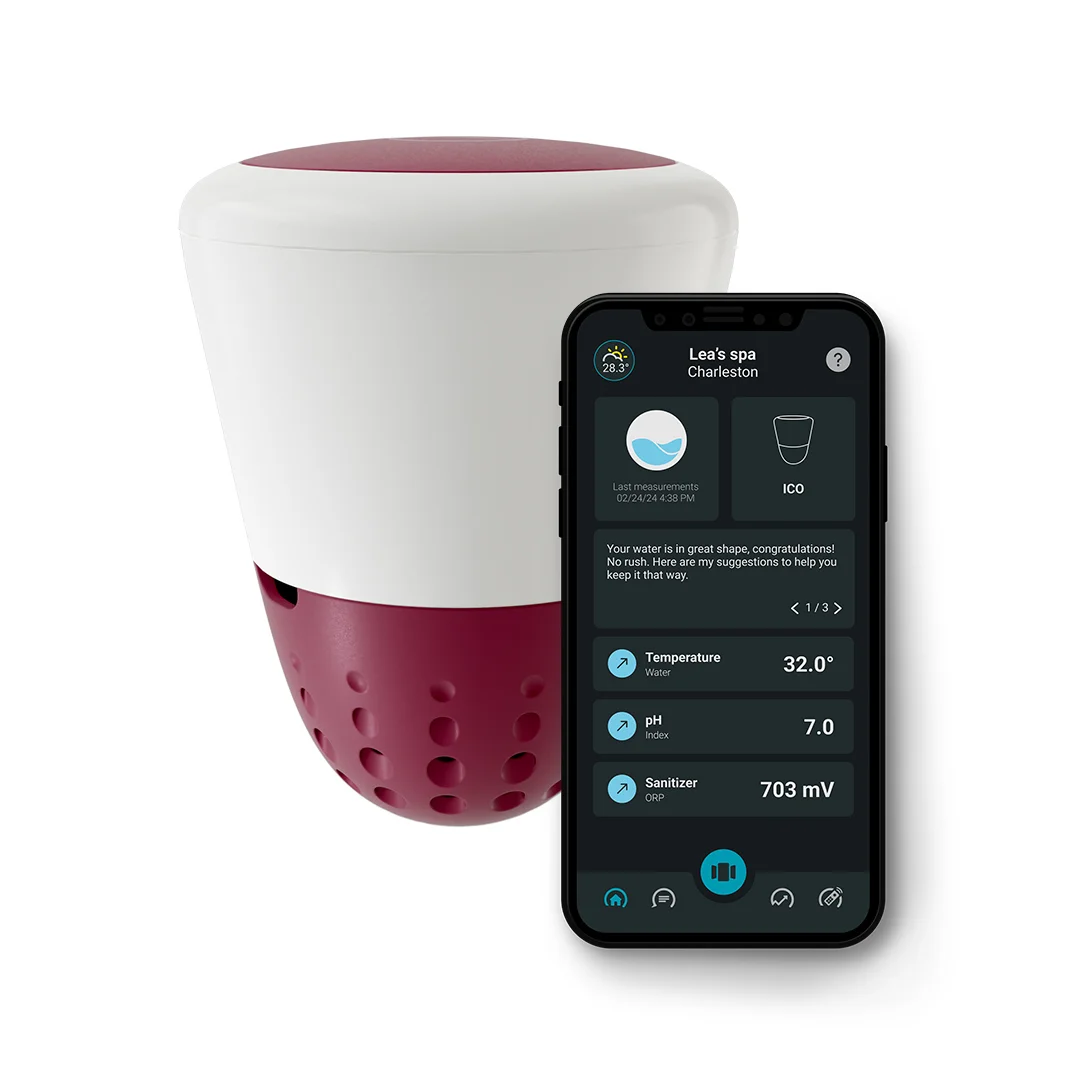
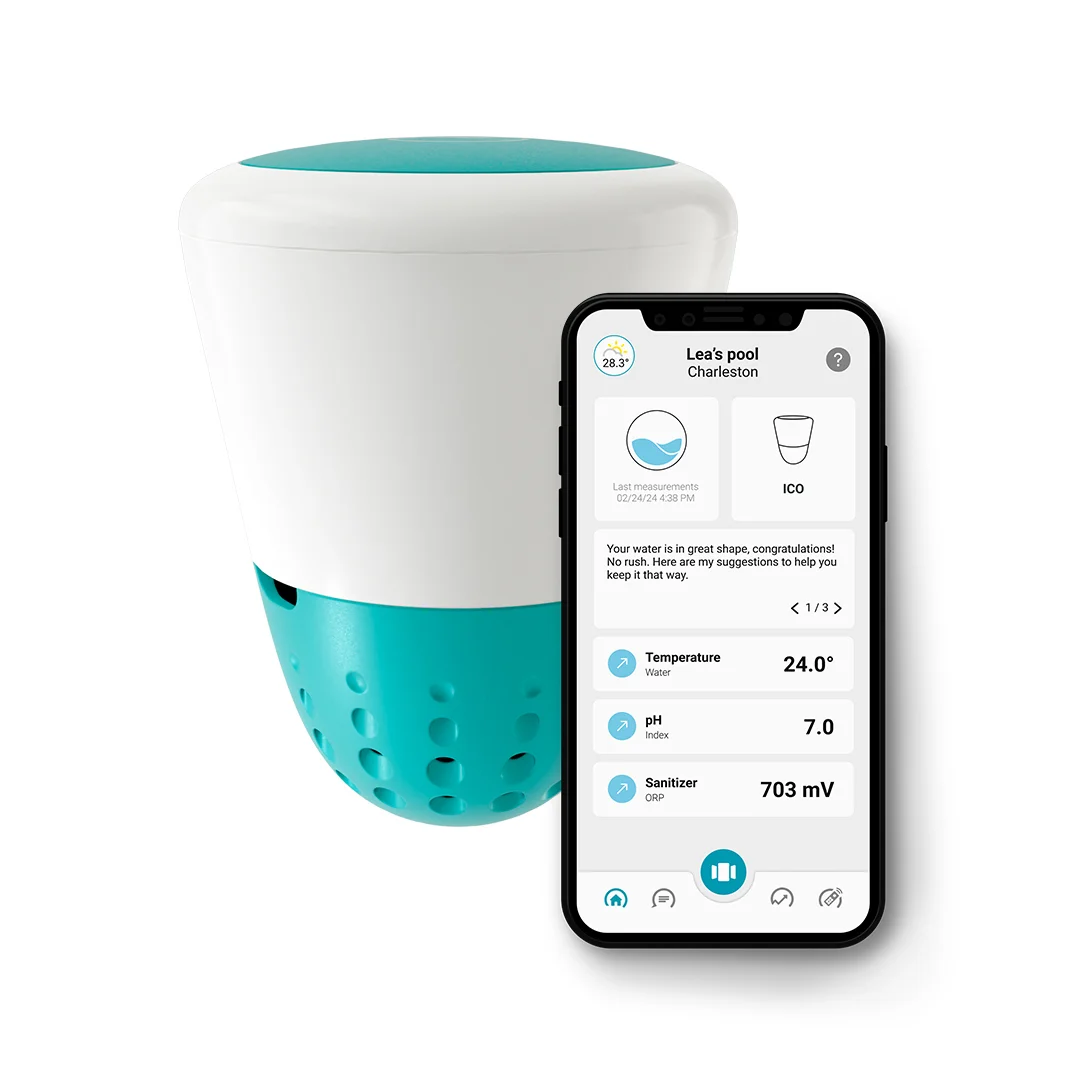
ICO pool is a smart device that measures parameters such as pH, disinfection levels and water temperature once an hour. Depending on how the readings change, ICO pool guides you by providing recommendations via the ICO app. ICO pool tailors its advice to the size of your pool and the treatment products you use. In this way, ICO pool saves you the hassle of common pool maintenance issues such as cloudy water, green water and overdosing…


Swimming pool water filtration
Just like water balance, water filtration also plays a vital role
Filtration time
Remember this rule: the filtration time should be equal to half the water temperature. For example, 14 hours of filtration for water at 28°C.
Filter status
Don't forget to check the condition of the filter (and clean it regularly), as well as the filter pressure. If the filter pressure is too high, the filter is probably clogged.
More about swimming pool water filtration or the spa water filtration
Cloudy swimming pool water: causes and solutions
Cloudy water is one of the most common problems faced by pool owners. It is characterised by a loss of clarity, making it difficult to see the bottom of the pool or any objects submerged in the water. There are many possible causes, but chemical imbalance in the water is often the main culprit.
| Causes | Solutions |
| – water imbalance ==> presence of algae, bacteria and particles | – measure water parameters – adjust the pH and total acidity, and carry out a shock treatment |
| – inadequate or clogged filtration ==> presence of sand, dust, algae | – clean the filter – die Filterzeit anpassen |
Cloudy water: water imbalance, examples and water treatment
Water imbalance
pH is undoubtedly the primary factor responsible for water imbalance. When the pH level fluctuates, the water can become cloudy and the effectiveness of certain treatments is reduced. A pH level that is too high causes limescale and dissolved metals (iron, manganese) to precipitate. These suspended particles scatter light, giving the water a milky or cloudy appearance
A practical example of chemical imbalance in swimming pool water
Let’s imagine a swimming pool whose water becomes cloudy after a few days of hot weather and heavy use. Here are the measured values:
- pH: 8.2 (too high; ideal range: between 7.0 and 7.4)
- TAC (Total Alkalinity): 50 ppm (too low; ideal range: between 80 and 120 ppm)
- Free chlorine: 0.5 ppm (too low; ideal range: between 1.5 and 2.5 ppm)
In this case, the water is out of balance. A high pH level reduces the effectiveness of chlorine, encouraging the growth of algae and bacteria. A TAC that is too low makes the water unstable and corrosive, whilst a lack of chlorine prevents the water from being properly disinfected.
How can you correct an imbalance in the water?
- Adjusting a pH that is too high: add pH- to bring the pH back to between 7.0 and 7.4 to optimise the effectiveness of the chlorine
- Increase the TAC: add TAC+ to reach 80–120 ppm and stabilise the pH
- Carry out an intensive treatment: pour the product in the evening whilst the filter is running, and leave it to work overnight
- The next day: clean the filter and test the water parameters. If necessary, use a flocculant to clump together the fine particles
Cloudy water: inadequate filtration – examples and solutions
Ineffective or unsuitable filtration is also a major cause of cloudy water. Even if the water is chemically balanced, a faulty filtration system is unable to remove fine particles, algae or suspended bacteria.
An example of inappropriate filtration
Let’s take the example of a 50 m³ swimming pool fitted with a sand filter whose flow rate is insufficient or whose filter media (sand) is clogged. Here are the signs to look out for:
- A good chemical balance (correct pH, chlorine and TAC levels).
- The filter pressure gauge shows an abnormally high pressure (0.5 to 1 bar higher than normal).
- The water return flow in the swimming pool is low.
Steps to follow to resolve the filtration issue
- Check that the filtration time is correct
- Check the pressure on the filter gauge. High pressure indicates that the filter is blocked.
- If the pressure is normal but the water remains cloudy, the flow rate may be insufficient for the size of the pool
- Clean the filter: for a sand filter, perform a backwash
Cloudy swimming pool water: causes, real-life examples and solutions
White water is characterised by a whitish colour, as if milk had been poured into the pool, whilst remaining translucent. This phenomenon is usually linked to chemical issues or reactions between products. Here are the main causes, specific examples and solutions to remedy the problem.
| Causes | Solutions |
| – chemical overload following a shock treatment | – check the chlorine and pH levels – stop treatment – leave to settle |
| – a chemical reaction between incompatible substances | – check product compatibility – filter |
| – presence of metals following treatment | – use a metal chelating agent (if necessary) |
Following a chlorine shock treatment, dead white algae can float to the surface, giving the water a milky appearance. You need to act quickly to sanitize your pool. Then remove as much algae as possible with your landing net. If you use a clarifier or flocculant (see the paragraph at the bottom of the page, Difference between clarifier and flocculant, to find out which product is compatible with your filter and how to use these products) before activating water filtration.
White water: excessive chemical levels following a shock treatment
An excess of chlorine, flocculant or other treatment chemicals can cause a chemical reaction that turns the water white.
White water: a chemical reaction between incompatible substances
Mixing incompatible products – highly effective anti-algae treatments containing quaternary ammonium compounds are incompatible with unstabilised chlorine and certain flocculants – can cause white precipitates to form.
White water: presence of metals
Certain treatments (such as aluminium-based flocculants) or water with a high iron content can leave metal residues in suspension.
Practical example: After using an aluminium-based flocculant, if the pH is too high, the aluminium precipitates and turns the water white.
How to diagnose white water
Check the most recent treatments applied
List the products used in the last 48 hours (chlorine, flocculant, algaecide, pH regulator, etc.).
Note the dosages: Overdosing (e.g. more than 20 g of shock chlorine per m³, or a double dose of flocculant) is often to blame.
Check for incompatibilities:
Algae control products containing quats (quaternary ammonium compounds) are indeed common, but must not be mixed with chlorine or aluminium-based flocculants.
Test the waters
- Measuring free chlorine: A level above 5 ppm may indicate an overdose.
- Check the pH: A pH higher than 7.8 promotes the precipitation of metals and limescale.
- Testing for hardness (TH): A high TH level (> 400 ppm) combined with a high pH can cause white cloudiness caused by limescale.
- Check for the presence of metals: take a water sample in a clear glass and add a drop of metal chelating agent (if available):
- If the water clears up again, the problem is caused by metals.
- If it remains white, it is probably due to an excess of chlorine or flocculant.
Solutions for treating white water
Stop adding chemicals to avoid making the situation worse
Allow to settle: wait 24 to 48 hours to allow the particles to settle at the bottom of the pool
Check product compatibility: consult the product instructions to ensure that they can be mixed safely.
Filtering the water: switch on continuous filtration to remove suspended particles. If necessary, use a clarifier to clump together fine particles and make it easier for the filter to remove them.
Tester et ajuster l’équilibre de l’eau : vérifier le pH, le TAC et le TH. Un pH entre 7,0 et 7,4 et un TAC entre 80 et 120 ppm aident à stabiliser l’eau.
Clean the filter: if the filter is clogged, clean it or backwash it to maximise its efficiency.
Use a metal chelating agent (if necessary): If metals are the cause of the problem, a chelating agent can help to neutralise them and prevent them from precipitating again.
Cloudy swimming pool water
Milky water is characterised by its opaque, whitish appearance, resembling skimmed milk, with very poor visibility (it is sometimes impossible to see the bottom). Unlike white water, which remains translucent, milky water is often linked to deeper-seated issues with water quality or filtration.
| Causes | Solutions |
| – excessive limescale or scale, combined with a pH that is too high | – measure the total hardness (TH) and pH – lower the pH by adding pH- – add a limescale inhibitor if necessary – scrub the walls to remove limescale deposits. – vacuum or use a robot vacuum to remove any residue. |
| – presence of bacteria or microorganisms | – undergo an intensive treatment – check the stabiliser level – clean the filter – increase the filtration time |
| – a problem with the filtration or water circulation | – clean or replace the filter – increase the filtration time – use liquid flocculant |
| – overall chemical imbalance | – measure pH, total ammonia nitrogen (TAN), and chlorine – restore the water’s balance – undergo an intensive treatment – add a suitable flocculant – leave to infuse for at least 24 hours – vacuum up the deposits at the bottom and scrub the sides |
Excess limescale
The presence of limescale in the water may be temporary (caused by an imbalance in the water) or linked to the water quality in your area. In this case, it is essential that you adjust your entire pond maintenance routine by using suitable products.
A total hardness (TH) that is too high (> 400 ppm) combined with a high pH (> 7.8) causes limescale to precipitate in the form of microcrystals, making the water look cloudy. This phenomenon is exacerbated by heat.
Practical example: A swimming pool filled with very hard water (TDS = 500 ppm) and poorly regulated pH (8.2) will see its water turn cloudy within a few days, particularly following a rise in temperature (e.g. after a heatwave).
Solutions
- Lower the pH to 7.2–7.4 using a pH-lowering agent (sulphuric or hydrochloric acid).
- Add a limescale remover (e.g. citric acid or a specific product) to dissolve the crystals.
- Consider decarbonation if the total hardness (TH) exceeds 500 ppm: partially drain the system and top up with softer water, or install a water softener.
Proliferation of microorganisms or bacteria
Inadequate disinfection (too low a chlorine level, a clogged filter) allows bacteria or microscopic algae to proliferate, which scatter the light and give the water a milky appearance.
Practical example: After a spell of rain or heavy use, the chlorine level drops to 0.5 ppm and bacteria begin to grow, causing the water to turn cloudy within 24 hours.
Actions to be taken
- Carry out a shock treatment: 15–20 g of unstabilised chlorine per m³. Leave to work for 24 hours whilst the filter is running continuously.
- Check the stabiliser level (cyanuric acid): it must not exceed 70 ppm, otherwise the chlorine becomes ineffective.
- Clean the filter and increase the filtration time to 12 hours a day until the water clears.
Problem with filtration or water circulation
A faulty filter, insufficient flow rate or too short a filtration time (< 8 hours per day in summer) will not remove fine particles.
Practical example: A clogged sand filter (with pressure 1.5 bar above normal) no longer retains impurities, and the water becomes cloudy despite the chemical balance being correct.
What can be done to restore crystal-clear water?
- Clean or replace the filter media (sand, cartridge, diatomaceous earth).
- Increase the filtration time: at least 12 hours a day during hot weather or after heavy use.
- Use a liquid flocculant (compatible with the type of filter) to agglomerate the particles and make them easier to remove.
Global chemical imbalance
An unstable pH, low total alkalinity (TAC) (< 80 ppm), or poorly stabilised chlorine disrupt the water’s balance and encourage the formation of persistent cloudiness.
Practical example: pH = 7.9, TAC = 60 ppm, chlorine = 0.8 ppm → the water remains cloudy despite several treatments.
Steps to restore crystal-clear water:
- Test all parameters (pH, TAC, TH, chlorine, stabiliser).
- Restoring the water balance
- Carry out a shock treatment (using chlorine or active oxygen) + a suitable flocculant.
- Leave to filter for 24 hours until the liquid has cleared.
- Vacuum up the deposits at the bottom and scrub the sides
How to avoid cloudy water ?
To take care of your pool or spa and prevent the water from changing too much, you should always go back to the two basics:
- Perform regular maintenance on your pool /spa and equipment. Here is the maintenance routine to clean your pool properly .If you have a hot tub,, read our practical guide to spa maintenance.
- A regular reading of water parameters (regularity depends on season, water temperature, number of bathers) will enable you to detect its slightest changes and be able to react before the situation becomes too problematic.
FAQ about cloudy water
Can I swim when the water is cloudy?
Generally speaking, it is not advisable to swim when the pool water is cloudy, white or milky. As always, the answer depends on how badly the water has deteriorated.
- If you can no longer see the bottom of the pool, you should refrain from swimming, as there are significant health risks.
- If the water is slightly cloudy, it may cause skin or eye irritation. It is therefore not recommended, particularly for young children or pregnant women. You must shower after swimming.
In a spa environment, the water temperature significantly increases the rate at which bacteria multiply; swimming is strongly discouraged until the problem has been resolved.
What is flocculant used for?
Pool or spa flocculants are used to complement water treatment (such as pH adjustment or the presence of dead white algae). They can be used when the water is cloudy, as they improve filter efficiency, disinfection and water clarity.
However, please ensure you use a flocculant that is compatible with the type of filter you are using.
- If you have a diatomaceous earth filter, you cannot use a flocculant; you must use a clarifying agent that is recommended for this type of filter.
Find out more at swimming pool flocculant
What's the difference between flocculants and clarifiers?
Both of these solutions help the filtration system designed to treat cloudy water.
Pool or spa flocculants have a binding effect that causes micro-particles to clump together, making it easier for the filter to remove them. This product requires more work and is also less water-efficient. You will need to run the pool cleaner to collect the sediment that has settled at the bottom of your pool and then top up the water level.
The clarifier removes particles via the filtration system without the need for a vacuum cleaner. Although it takes longer to work than a flocculant, the clarifier does not clog the filter with impurities and suspended particles. This product is recommended for diatomaceous earth or sand filters. It is often used following a shock treatment.
How long does it take for the water to become clear again?
It depends on the cause (pH, limescale, a clogged filter, particles). Generally speaking, if the parameters are corrected and the filtration is effective, an improvement can be seen within 24–72 hours, though it may take longer if the filter is saturated or the water is heavily contaminated. (A useful guide, to be adapted to the specific situation)
Cloudy water is a common problem: what should you check first?
- Check: (1) pH, (2) filter condition/filtration time, (3) total hardness (TH)/total alkalinity (TAC) if your water is naturally hard,
- Adjust your routine after heavy use of the pool or extreme weather conditions (heat, storms, etc.)
What to bear in mind if your pool water becomes cloudy, white or milky:
To restore crystal-clear water, check and correct:
- parameters: pH, total dissolved solids (TDS), total hardness (TH), chlorine, disinfection
- filtration quality: filtration duration, condition of the filter
- depending on the identified cause, apply the appropriate solution