Measuring ORP (or redox potential) enables the effectiveness of water disinfection to be assessed. The higher the ORP value, the more effective the water is at eliminating harmful micro-organisms, thereby ensuring better water quality for public health. Now a regulatory standard in many countries, ORP is considered more reliable than simply measuring chlorine or bromine levels. In this guide, we explain what ORP is and cover several key aspects: what is the ideal ORP level, what action to take if the ORP is too low or too high, what factors cause variations, and how to measure ORP?

Key facts about ORP – redox
ORP definition
ORP (Oxidation-Reduction Potential) measures the disinfection effectiveness of your swimming pool or spa water. An ORP probe, found on an electronic tester or a connected water analyser, measures the electrical potential generated by all chemical disinfectants. It is expressed in millivolts and indicates the water’s overall oxidising potential. However, it does not directly measure the amount of chlorine or bromine.
By measuring the actual water disinfection efficiency (ORP), you no longer have to guess. Your automatic system (pump or electrolyser) or your manual chemical additions adapt to the pool’s actual needs. The result: you buy fewer chemicals and protect your equipment from excess chlorine.
What is the ideal ORP level for a swimming pool or spa?
For optimal water disinfection at 25°C, the World Health Organisation (WHO) considers that water is properly disinfected and has disinfectant properties from 650 mV upwards. In private swimming pools, the ideal range is between 650 mV and 750 mV.

When the ORP is greater than 800–850 mV, the water becomes too corrosive (red eyes, wear and tear on the liner). Swimming is strongly discouraged.
When the ORP is less than 500 mV, swimming is strongly discouraged, as the water no longer has any disinfectant properties.

Whether in a swimming pool or a spa, the ideal ORP remains technically the same (650 to 750 mV) to ensure that germs are destroyed, whether in 50 m³ or 1 m³. However, the process required to achieve this changes radically.
This range of values should be used as a guide, as the interpretation depends on the configuration of the basin and other water parameters.
Variation factors of the ORP
It is normal to see variations in your ORP readings, as ORP varies depending on UV light, but above all on the pH of the water.
If your readings vary by +/- 50mV over the course of a day during the high season, there is not necessarily any action required. You simply need to check your pH and water temperature levels regularly.

pH: the undisputed number one factor
In a chlorinated or salt-water swimming pool:
- The higher the pH, the less effective the chlorine is. The water’s disinfecting power – in this case, the ORP – is therefore low.
- If you notice a low ORP, it is essential to test the pH of your pond water.
- If the pH is higher than 7.6, then it is outside the optimal range (between 7.2 and 7.6). It is therefore necessary to to lower the pH of the water.
At exactly the same chlorine level, a change in pH from 7.2 to 7.8 can cause your ORP to drop by more than 100 mV.
In a brominated swimming pool :
- Bromine is more stable and tolerant of high pH levels. This is why the optimum pH range is higher: between 7.4 and 7.6. At a pH of 8.0, bromine is 80 per cent effective, compared with just 20 per cent for chlorine.
- If the ORP is low, check the pH.
- If the pH is less than 7.4, the pH is not the issue: this is a sign of a bromine deficiency.
the stabiliser concentration: the second factor
The stabiliser protects the chlorine from the sun’s UV rays. The stabiliser chemically binds to the chlorine. As long as the chlorine is bound to the stabiliser, it remains dormant: it cannot destroy algae and bacteria. The redox probe detects only ‘free and active’ chlorine.
As soon as the stabiliser level exceeds 30 to 40 ppm, the ORP drops dramatically, even if your test strips indicate that there is plenty of chlorine present.
Above 70 ppm, the chlorine is over-stabilised, the sensor becomes ‘blind’ and the ORP remains stuck at a very low leve
pollutant load: the third factor
When several bathers enter the water at the same time, they introduce sweat, sun cream, saliva or cosmetic residues. Leaves and pollen have the same effect. Active chlorine or bromine immediately reacts with these pollutants to break them down.
During the disinfection process, the amount of available active chlorine drops instantly. The ORP drops sharply during and immediately after swimming, whilst the treatment system removes the contaminants.
| Variation factor | Level of importance | If the factor increases, the ORP … | If the factor decreases, the ORP … | Recommended actions |
| pH | ***** critical | plummets | is increasing | keep the water pH between 7.0 and 7.4 for chlorine, and between 7.2 and 7.6 for bromine |
| stabiliser | **** major | is collapsing | is increasing | Do not exceed 30–40 ppm |
| pollution caused by bathers and the environment | **** major | is falling rapidly | se stabilise | anticipate an increase in filtration or boost function |
| free chlorine / free bromine | *** moderate | is increasing | is decreasing | add chlorine or bromine, or adjust the setpoint on the electrolyser |
| temperature | ** low | is decreasing | stable | Increase the filtration time and monitor the pH when the pool water temperature rises |
As ORP depends on several factors, it is therefore best not to interpret an ORP value in isolation.
A single reading is not sufficient to make a diagnosis. It is necessary to monitor how it changes and compare it with measurements of pH, temperature and disinfectant levels
How do you measure the ORP of a swimming pool or spa?
Tools for measuring ORP
ORP can be measured using:
- a portable electronic tester
- a smart water analyser fitted with an ORP (Redox) probe
- a sensor integrated into a control system (electrolyser, dosing pump)
To obtain reliable results, regardless of the measuring instrument used, the ORP probe must be kept clean, properly maintained and used, and calibrated regularly in accordance with the manufacturer’s recommendations.
A one-off measurement using an electronic tester measures the ORP at a specific point in time. Whereas a connected water analyser allows you to monitor changes in the ORP over time and detect any drift.

Why choose a smart water analyser with an ORP probe?
A one-off measurement provides an indication of the water’s condition at a specific point in time. A connected analyser allows you to monitor changes in ORP on a regular basis and interpret these alongside other measured parameters, in particular pH and water temperature.
Discover ICO POOL V2 Essential + the smart water analyser for swimming pools
Finally, you should be aware that there is a product called ICO Pool, a smart water analyser for swimming pools that measures the pH, temperature and disinfection levels of the water.
- measurements once per hour : pH, ORP-Redox, temperature, and TDS for the salt version
- personalised recommendations based on the volume of your pool and the treatment products used.
- a Wi-Fi connection
- a rechargeable battery
- a calibration kit included


What are the benefits of ICOs?
By measuring ORP, ICO gives you a comprehensive overview of the disinfection quality of your pool water (pH, temperature), unlike other testing tools such as colourimetric test strips, which measure total chlorine or free chlorine, or electronic ORP/REDOX testers (which provide one-off readings).
- Automatic measurements : Every hour, ICO takes readings at several points around the pool. ICO measures all the key parameters required to maintain a balanced water environment. It then analyses these readings over time to produce an accurate assessment of water quality, before formulating a personalised recommendation on when to add the appropriate product.
- Find out more about the measurements carried out by ICO
- Cross-analyses and personalised recommendations : ICO doesn’t just analyse the water in your pool. It also sends you recommendations for chemical treatments via your smartphone, specifying the product and dosage to use. These recommendations are tailored to whether you use tablets, liquid or other forms of product. It adjusts the quantities according to the volume of your pool or spa.
- See all ICO recommendations
- Easy to track via the app : readings, graphs, recommendations and notifications can be accessed via the ICO app.
- Discover all the Key features of the ICO app.
Why is measuring ORP more effective than measuring the chlorine level?
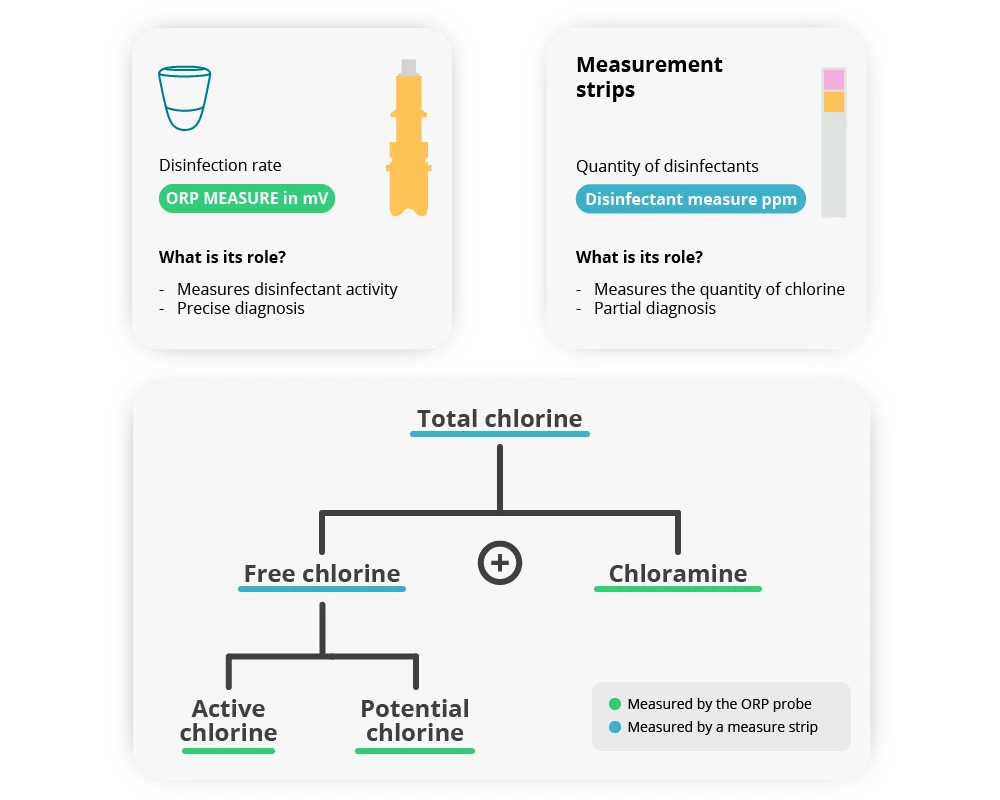
To understand why your connected analyser or electronic tester sometimes displays results that are completely at odds with those from your test strips, it is important to realise that chlorine changes form in water. There are three types of chlorine:
- Total Chlorine: This is the full force. It includes both active chlorine and ‘spent’ chlorine (chloramines), which has already fought off bacteria. This spent chlorine no longer disinfects, but it is what gives off the strong smell and stings the eyes.
- Free Chlorine: This is the reserve of soldiers ready for battle. It is exactly what your standard test strips measure. The test strip counts the number of troops available in the water, but it cannot tell whether they are immobilised or fit for action.
- Active Chlorine: This is the elite force. It is the one and only fraction of free chlorine that is actually capable of destroying algae and bacteria immediately. Its concentration depends entirely on your pH level and the stabiliser. This is what the ORP probe measures.

The difference between a test strip and an electronic ORP metre is a question of quantity versus quality:
- The test strip measures the AMOUNT (free chlorine):
- It shows the amount of disinfectant reserve present in your water
- When you dip it in water, it says: ‘You have 1.5 mg/L of chlorine; the tank is full’. But it cannot tell you whether this chlorine is effective or whether its activity is inhibited by a pH that is too high.
- The ORP probe measures the QUALITY (active chlorine):
- It doesn’t count the milligrams of the product.
- It captures the electricity released solely by active chlorine. The ORP measures the actual effectiveness and rate of action of this chlorine.
- An ORP of 700 mV ensures that the water is actively disinfecting and will destroy viruses and bacteria in a matter of seconds,
- Whereas a low ORP means that the chlorine will take hours to take effect, giving the algae time to grow.
- Knowing the ORP ensures that the chlorine present is doing its job properly.
Example:
- If your pH drifts to 7.8:
- your test strips will turn bright pink, reassuring you that your chlorine level is perfect. However, at this pH level, the chlorine is bound.
- Your ORP sensor, however, will not be fooled: it will display a very low reading (e.g. 580 mV) to alert you that your water is no longer protected, despite the physical presence of chlorine.
Why monitor ORP and pH at the same time?
As we have seen previously, pH is the primary factor that directly influences ORP.
A low ORP does not therefore automatically mean that more chlorine or bromine needs to be added.
It may be due to a pH that is too high, an excessive amount of stabiliser, a high organic load or inadequate filtration.
Measuring pH and ORP simultaneously makes it easier to distinguish between these situations and avoid inappropriate correction.
Discover: How to measure and adjust the pH of your swimming pool
What should you do if the ORP is too low? Too high? Rising sharply? Fluctuating regularly?
What to do when the ORP is too low?
Below 650mV, the water is not sufficiently disinfectant. Il there is a significant risk of bacterial proliferation in the water and the appearance of algae. Swimming is therefore strongly discouraged. In addition, a low REDOX/ORP reading can lead to green pool water. .
You have just filled your swimming pool or spa
It's normal to have a low disinfection level if you've just filled your pool.
The ORP has been low for a few days
If your swimming pool is treated with chlorine or salt, check the pH
- If the pH is greater than 7.5, the pH inhibits the action of the chlorine. You will need to lower the pH by adding pH-. The ORP will rise again on its own.
- If the pH is correct (between 7.2 and 7.4) but the ORP remains low:
- measure free chlorine and the stabiliser (cyanuric acid)
- if the free chlorine level is close to 0 mg/L. Add a chlorine tablet or increase the operating time of your chlorinator.
- If the chlorine level is correct but the stabiliser is above 60 ppm, the water is over-stabilised. The stabiliser has ‘locked in’ the chlorine, rendering it ineffective. You need to dilute the stabiliser by draining some of the water from the swimming pool or spa, then refilling it with ‘fresh’ water.
- If the pH is < 7, start by raising the pH by adding pH+. Switch the filter to forced operation. Wait 2 hours. Then, check the pH and the free chlorine level. If the chlorine level is indeed close to 0 mg/L, you can add chlorine.

If your swimming pool is treated with bromine
- As bromine is less sensitive to pH, a low ORP almost always indicates a shortage of the product, regardless of the pH. In this case, add bromine.

What should I do if the ORP is too high?
An ORP reading above 800 mV indicates that your disinfectant is highly active.
If the reading rises sharply (above 850 mV), the water may cause irritation to the eyes and skin. Furthermore, this may damage your equipment and cause the lining of your swimming pool or spa to fade. You are therefore advised not to swim.
Check the pH
As when the ORP is too low, you need to check the pH of your pool/spa water.
- If the pH is less than 7, it is the acidity of the water that is artificially boosting the ORP. Add pH+. As the pH rises, it will naturally neutralise the chlorine/bromine and bring the ORP back down.
- If your pH is correct (between 7.2 and 7.5): the water simply contains too much of the product.
- If you have an electrolyser or a dosing pump: Switch off the appliance or reduce its operating time.
- If you are treating the water manually (with chlorine or bromine): Temporarily remove the chlorine tablet from the skimmer or the bromine from the dispenser, and uncover the pool. The sun’s UV rays will naturally break down the excess disinfectant within a few hours.

- If the pH is high (> 7.6 or 7.8):
- In a swimming pool or spa treated with chlorine or salt
- This is a sign of a massive overdose of disinfectant (as liquid chlorine or salt treatment naturally tends to raise the pH). The amount of product is such that it causes the ORP to skyrocket despite the high pH.
- ⚠️ Warning – Safety rule: Do not attempt to lower the pH immediately using pH-. Making the water more acidic would instantly release the full potency of the excess chlorine, making the water even more corrosive. Switch off your disinfection unit immediately, uncover the pool to allow the UV light to break down the excess chemical, and wait until the ORP has dropped below 750 mV before adjusting the pH.
- In a bromine-treated swimming pool or spa
- It’s simply that the bromine dispenser or brominator has released too much of the product. As bromine remains highly effective at high pH levels, the ORP shoots up.
- Temporarily remove the bromine from the dispenser or switch off the brominator to lower the level, and you can add pH adjuster – straight away – to bring the pH back to between 7.4 and 7.6 for a comfortable swimming experience.
- In a swimming pool or spa treated with chlorine or salt

What should you do when the ORP rises sharply?
A rise is considered ‘abrupt’ when there is a sudden jump of 100 to 200 mV within a few hours, pushing the ORP value above 800 mV, or even above 900 mV (whereas the ideal target is generally between 650 and 750 mV).
The reasons behind a sharp rise in the ORP and what action to take
- The roller shutter effect: for swimming pools fitted with an electrolyser or a dosing pump
- You have closed the pool cover or shutter.
- By blocking the sun’s UV rays (which naturally break down chlorine), chlorine builds up quickly in the pool.
- Chlorine overdose (manual):
- Find out if there is a swimming pool or spa
- UV light will break down free chlorine within a few hours
- A bromine overdose:
- Check whether the swimming pool or spa is fitted with a cover or a roller shutter,
- Wait a few days, as it will take several days for the bromine levels to drop back down on their own
- or use a specific neutraliser
- A recent intensive treatment:
- You have carried out a shock chlorination treatment: the ORP will remain very high for 24 to 48 hours before returning to normal, whilst the product breaks down the impurities.
- You have added active oxygen: this product chemically interferes with the ORP probes, causing the reading to shoot up (sometimes to over 900 mV). You will need to wait several days for the product to evaporate before you can obtain a reliable reading.
- After backwashing the sand filter:
- By cleaning the filter, you remove the organic matter that was consuming your disinfectant. Furthermore, the influx of fresh tap water (which is highly oxygenated) stimulates the ORP probe, causing a temporary rise in the reading.
- A probe whose ORP readings have drifted:
- If none of the above reasons apply, your ORP probe may need to be cleaned and recalibrated using a reference solution. (Please refer to the manufacturer’s instructions for use.)

What should you do when the ORP fluctuates regularly?
A regular, repetitive variation in ORP (which rises and falls at the same times or at the same rate) is not an anomaly. To know what to do, you must first identify the ORP variation pattern.
Day/night cycle: the most common
This is the most common variation in outdoor pools, particularly in those treated with salt (electrolysis) or liquid chlorine, as these methods use little or no stabiliser.
Example: The ORP is at its lowest in the middle of the afternoon (e.g. 580 mV at 3 pm) and rises to its maximum at the end of the night (e.g. 720 mV at 6 am). The sun’s UV rays rapidly break down active chlorine during the day, causing the ORP to drop. As soon as the sun sets, the UV rays disappear, the chlorine builds up again, causing the ORP to rise.
If the average value remains within the correct range and the water is clear and crystal-clear, do nothing. This is the natural cycle of a healthy swimming pool.
Filtration cycle
L’arrêt et le démarrage de la filtration créent deux phénomènes très précis, qui font varier l’ORP de manière hyper régulière.
- When the filtration system is switched off:
- Surface water (the top 20 centimetres) heats up very quickly in the sun. It is also this surface layer that bears the brunt of UV rays (which break down chlorine) and impurities (pollen, insects). After just a few hours of standing still, the unstabilised chlorine at the surface is destroyed: the ORP drops. However, at a depth of 1 metre, the water has remained cooler and the chlorine there is intact.
- When the filtration system is working:
- The pump draws water in from the bottom (bottom drain) and from the surface (skimmers), mixes it all together and redistributes perfectly homogeneous water. The water from the bottom, which is in good condition, rises to the surface. As a result, the ORP rises to return to its true equilibrium value.
What should you do in this situation?
Here are the two golden rules:
- Ignore any readings taken whilst the pump is switched off. These do not reflect the actual condition of the water in your pool, but only the stagnant state of the surface. The only reading that matters is the one taken after at least one hour of continuous filtration.
- Filter during the day, not at night. To avoid UV-induced ORP fluctuations, run your filtration system continuously during the sunniest hours (for example, from 9 am to 6 pm). This ensures that chlorine or bromine is released continuously at precisely the moment when the sun and bathers are using it up.
In summary: on the ORP of a swimming pool or spa
More accurate than simply checking the chlorine level, measuring ORP (or redox potential) means you no longer have to guess – you can finally understand what is actually happening in the water in your swimming pool or spa. ORP tells you how effective your disinfectant really is, in real time.
This is precisely where a connected water analyser such as ICO comes into its own: by continuously measuring this value, it provides a real-time indication of the actual effectiveness of the treatment method used (chlorine, bromine, electrolysis) and saves you the trouble of tedious chemical calculations.
A change in the ORP almost always indicates a fluctuation in pH or an issue with the stabiliser. Before adjusting your disinfectant dosages, always check the overall balance of your water.